Try parts
in and out.
Business work runs once a week with customers in it, so you cannot try everything. Arranger finds the parts worth moving, writes each move before it runs, measures it against a control, and brings you the next two or three moves worth making.
Discuss your first part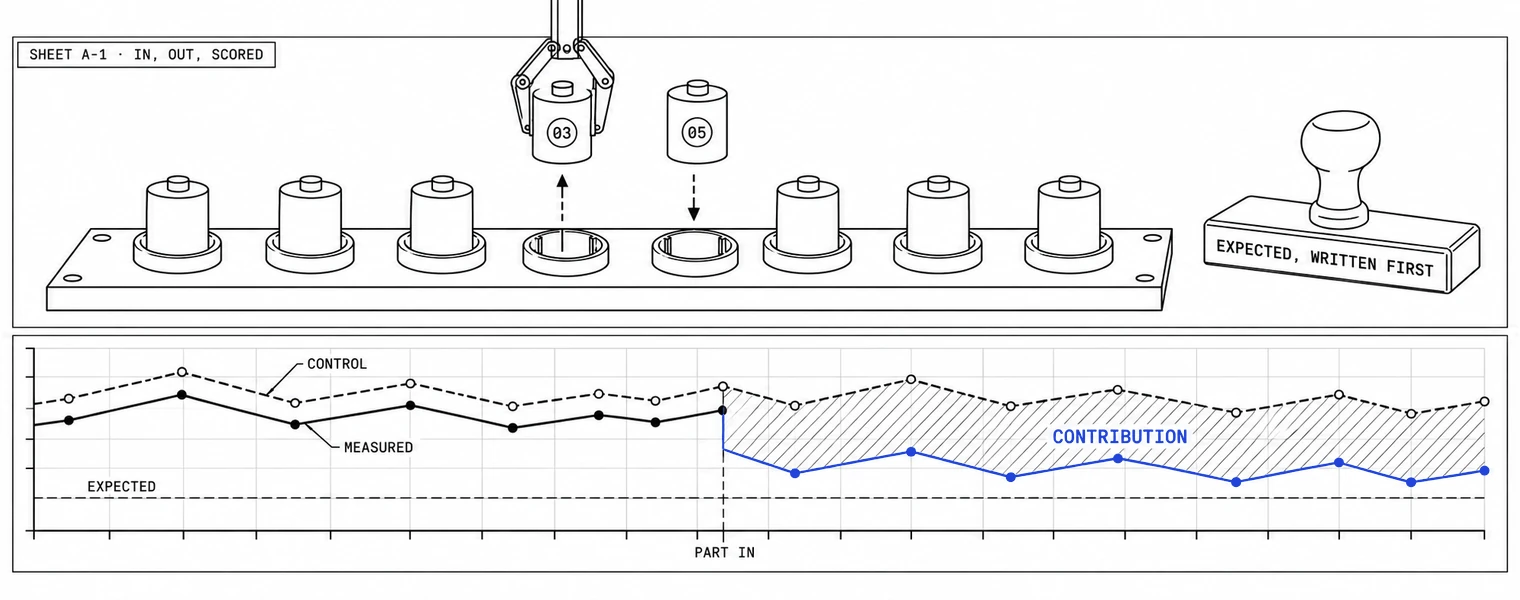
Fewer moves,
faster answer.
A product team can replay a thousand variants overnight. An order desk cannot. Every move on live work costs operating time and carries risk, so Arranger starts with the number, the parts that could change and a budget of moves. The aim is the fewest moves to an answer you can trust, and a stop when the number is credibly met. Two parts that work well alone can disappoint together, so Arranger scores the whole line.
Konstant’s mathematics finds the candidates.
Konstant reads the record behind the number. It measures how parts of the work interact, where a part is drifting from the number, and where work is happening that nobody asked for: orphans. That last kind is where the unlisted part usually hides. Agents propose the moves. People name them.
Precise’s mathematics scores the result.
Once a move has run, Precise’s mathematics assigns the measured change to the parts that changed and measures how parts interact. Two parts that help alone can hurt together, and the number says so before you ship them together. Konstant has published one such case, with the figures.
The published caseTwo or three moves,
then you judge.
Arranger never runs the whole matrix. It presents the next two or three moves most likely to change the decision, and a person picks. The expected result is written before the move. A miss rolls back by your rule.
Every move is written first.
One move, as written before it starts:
- Baseline
- The number today, dated to its source.
- Expected movement
- What the move changes, by how much, by when, with a range.
- Window
- The weeks it gets to prove it.
- Stop rule
- The result that ends it.
Once the move is scored, the record shows what was known, what was chosen, what was predicted at what confidence, and what happened. A miss rolls back by your rule. Arranger stops when the number is credibly met or when no remaining move can change the decision. Your existing tests and domain experts supply the measurements and the review.
Judgment
is a part.
Arranger ships with judgment discovery built in. Give it the record of what one person marked for years. It proposes the questions she might be weighing, asks them of every order, and keeps the ones that predict what happened. The result is her read on late orders as six questions she can read and correct, named at a revision with her name on it.
Precise inside Arranger.
Precise develops mathematics for measuring what each part of a result contributed and which move is worth trying next. Precise runs its own research workloads through Boombox, in its own cloud. Konstant’s agents called that part inside Arranger, beside Konstant’s own methods for finding overlooked evidence. Precise never designed it for that, and keeps its mathematics, its product and its customers. Konstant customers get a maintained part without building it.
Keep what the moves taught.
Every scored move stays on record: the combination, the prediction, the result. When Crossfade moves the work, what happens in use feeds the next move.
Move the work with CrossfadeWhich number
should move first?
Bring the number. Konstant proposes the parts to try first.
Discuss your first part