Aim the work.
Konstant holds the company context: revenue, roadmap, what customers said, what people marked. Sit down with it to choose the part, the number and the next product. Your agent arrives named Gary. Name it whatever you want.
Discuss your first part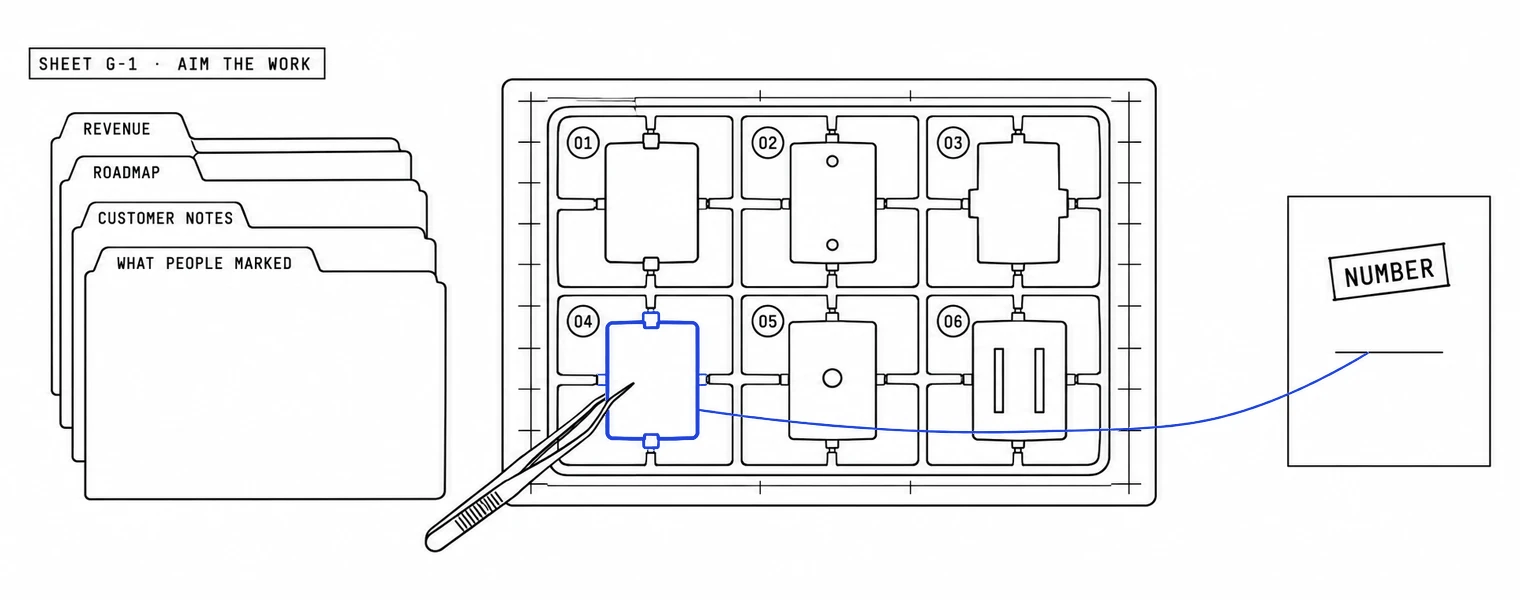
Choose the number.
Choose the part.
Margin, cost per order, cycle time: each moves with a handful of parts. You cannot move a number you cannot name. Bring Konstant a target and the record, and it shows which parts the number depends on.
Konstant reads the software and the methods behind the number and proposes the parts. Your people name them. At Blockdaemon, leadership brought Konstant a revenue target, the CRM warehouse, six months of pipeline, contracts and delivery notes. Konstant named the parts of the sales machine that were leaking.
Read judgment
from the record.
Konstant finds the judgment already working in the company. At Blockdaemon it found fifteen people practicing rules nobody had written down. For one person, Konstant reads the record of what she marked. Arranger turns it into a part she can read and correct.
Find what the priorities miss.
A recurring signal can sit outside a declared priority and still matter. Konstant’s selection methods bring overlooked evidence into the room beside the context you asked for: work that is happening that nobody asked for, and work drifting away from the number it was meant to move.
Design the
next product.
A new customer need becomes a new workflow: existing parts plus at most one new part. Your agents and the customer’s agents compose it toward the outcome.
Company context. Company control.
Connect the records and systems the work needs. Access follows the person and the source. The company’s figures, accounts and people stay with the company. The owner decides what a part means and who may use it.
One new part per customer need Try parts in and out with ArrangerWhich number do
you want to move?
Bring the number and one accountable owner. Konstant starts with the parts behind it.
Discuss your first part