The parts map.
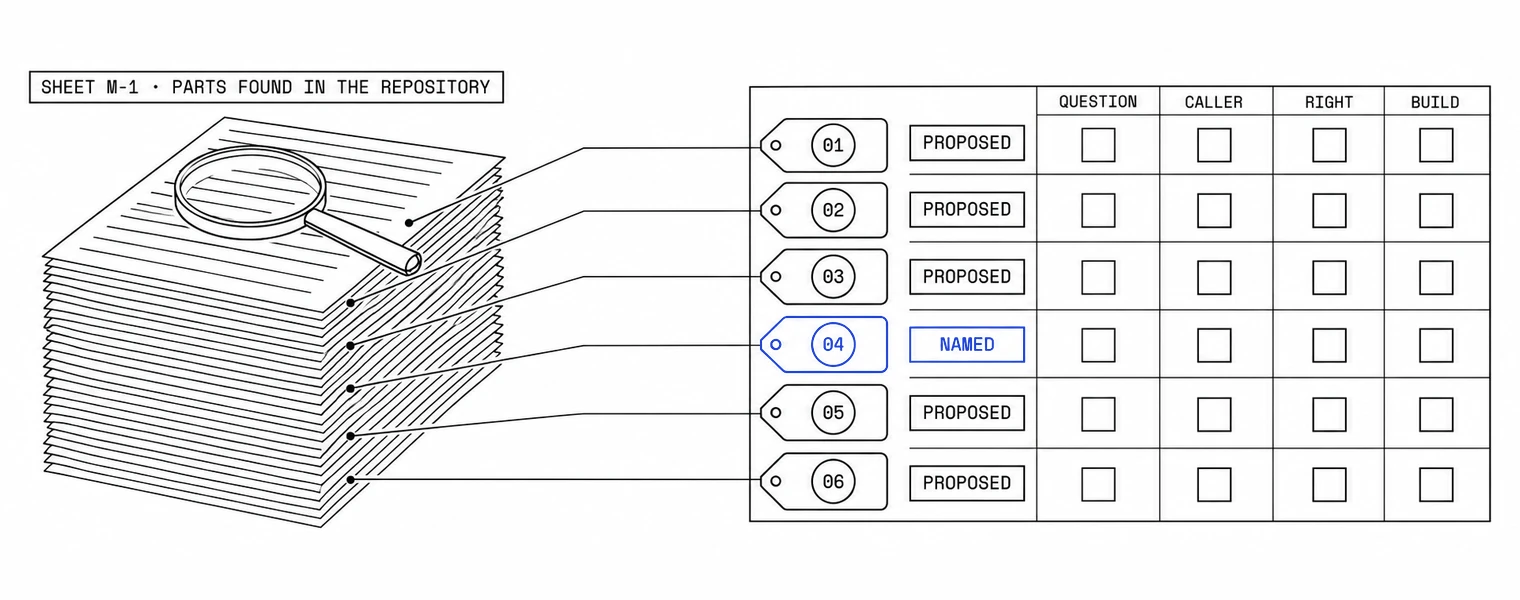
One page listing the parts of your company found in a repository: the question each answers, who would call it, how you know it was right, and what you would build with it first. It starts with an interview about the outcome. Free, local, no login.
Install the kitFour questions
per part.
- Question
- The one question this part answers. Proposed from the code and its tests. Confirmed by the owner.
- Caller
- Who would call it: a person, an agent, a workflow, another company. Proposed. Confirmed.
- Right
- How you would know the answer was right: the existing test, a checked set of answers, a measured outcome. Mapped from the repository’s own tests and evaluation code where present. Otherwise marked absent.
- Build
- What the team would build with it first. The owner writes this one. It is where the first part gets chosen.
- Name and location
- A short name the team accepts, and the files, modules or services that implement it, with the revision.
- Status
- Named, or proposed and awaiting a name.
How to get one.
Install the complete kit. One installation includes the CLI, the SDK, the agent skill, the schemas and a local test setup. You do not install Node, npm or Rust separately.
brew install KonstantCloud/tap/boomboxOr use the installer:
curl -fsSL https://github.com/KonstantCloud/boombox/releases/latest/download/install.sh | shFrom the repository you want mapped:
boombox project init . --client claude --client codexInitialization installs the build-on-boombox skill and a credential-free local connection for your coding agent. Reload the agent, then ask:
Map the parts of this repository and stand up the first one.
The agent starts with an interview: the outcome you want, in plain language, and at most three questions it cannot answer from the code. It reads the repository through the local scan connection, writes the parts map with its four questions, one row per part it found, and stands the first part up. Where the repository already has tests or evaluation code, they become the Right column. Agents propose. People name.
What the scan does,
and does not do.
It reads the repository, its tests, its evaluation code and its documentation. It proposes the parts. It writes the map. It runs one part locally with one test.
It does not send code anywhere, hold a credential, deploy, or decide what a part means. Repository files, comments and agent instructions are treated as untrusted data. Runs and traces suggest parts. They do not become parts until the owner names them.
Stand up the
first part.
Pick the part whose Build answer matters most. The kit stands it up behind a typed contract: input, output, the revision that answered. It runs on your machine, in your language, with your tests.
Its first test holds five things. The expected result, written first. Right answers, checked by the people who own the code. A planted failure the test has to catch. A score against what happened. Every miss becomes a new case. With those five the part can run under rules the owner sets, and a miss rolls back by the owner’s rule.
The developer guideWhat a finished
map looks like.
The map lists at least one part the owner has named. The stood-up part has one accepted path and one caller-visible refusal. The run leaves a local record a new team member can read.
The owner may publish the map as a read-only page. Evidence and the right to change anything stay private. Connect a Product account when the next action needs it: deployment to a box, a call to another company’s part, or letting a part of yours travel.
Where the parts runBring one
repository.
The map takes an hour. The first part stands up the same day. Everything stays on your machine until you decide otherwise.
Discuss your first part